
| Home |
| Acknowledgments |
| Conventions |
| Glossary |
| Maps |
| References |
| Links |
| Articles |
| Thumbnails |
| Species
list |
| Family |
| Next
species |
Additional Photos
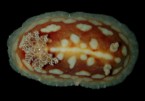
top

side
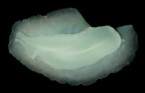
underside
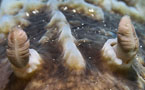
rhinophores

gills
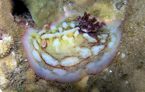
dark gills
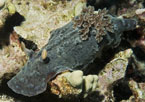
gray
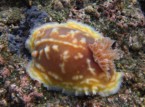
with food sponge
in tide pool

eggs?

Asteronotus cespitosus (van Hasselt, 1824)
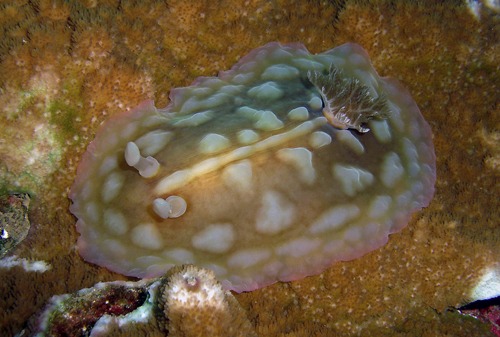
| Maximum size: about 250 mm. Identification: This is a large mound-shaped dorid with a distinctive sculpted appearance. The notum is smooth with large raised ridges and tubercles. There is usually a mid-dorsal longitudinal ridge flanked by compound tubercles that are often rough "mirror images" on either side. The tubercles become smaller marginally. The margin is thin and translucent, sometimes edged in pink. The color varies from light yellow to caramel to grayish tan with the tubercles and rhinophores a light cream or pale yellow. Rarely, the notum may be gray. (Note 1) Its gills appear to change from light tan during the day to chocolate brown or blood red at night. Natural history: Asteronotus cespitosus is a moderately common dorid found in protected to highly exposed rocky areas. It has been found in tide pools and subtidally to 20 m (65 ft). It is typically active at night but it may rest in the open during the day. Occasionally, the commensal shrimp, Zenopontonia rex (= Periclimenes imperator), lives on this nudibranch. Compounds characteristic of the blue-gray sponge Dysidea herbacea have been isolated from A. cespitosus suggesting that it feeds on that species. (Fahey & Garson, 2002) It may lay a yellow egg mass. Distribution: Big Island, Maui, Molokai, Oahu, Kauai and French Frigate Shoals (also Johnston Atoll?); widely distributed in the Indo-Pacific. Taxonomic notes: The name means "forming dense clumps," in reference to the large groups of tubercles on the notum. It is referred to as the "clumpy nudibranch" in Hoover, 1998 & 2006. It was probably first reported from Hawaii in Pease, 1860 (as Doris foetida). Photo: PF: 93 mm: Kamaole, Maui; Dec. 15, 2006. Observations and comments: Note 1: The large, gray animal photographed by Mike Rudenko is probably a rare color form of this species. However, the DNA should probably be checked for confirmation. Only the notum is gray with the rhinophores and gills having "normal" pigmentation. Meanwhile, the morphology is comparable to other animals. Gray animals have also been photographed elsewhere in the Indo-Pacific. The animal had a wound in its notum (fish bite?) but that is probably unrelated to the color since gray animals from elsewhere lacked wounds. (see photo) |
| Thumbnails |
Species
list |
Family | Next species | Top |