
| Home |
| Acknowledgments |
| Conventions |
| Glossary |
| Maps |
| References |
| Links |
| Articles |
| Thumbnails |
| Species
list |
| Family |
| Next
species |
Additional Photos
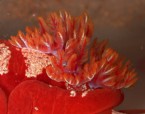
branchia
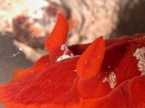
rhinophores
oral tentacles
anal papilla
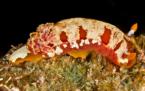
more white
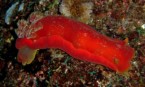
lightly spotted
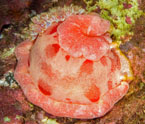
finely spotted
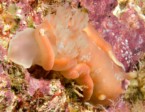
pale
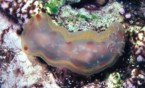
early transitional
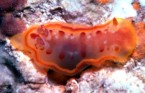
late transitional
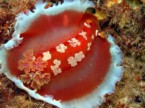
flared mantle
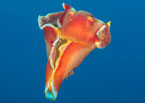
swimming
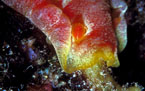
feeding
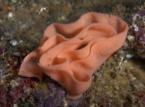
egg mass
_______________
GALLERY

Hexabranchus aureomarginatus Ostergaard, 1955
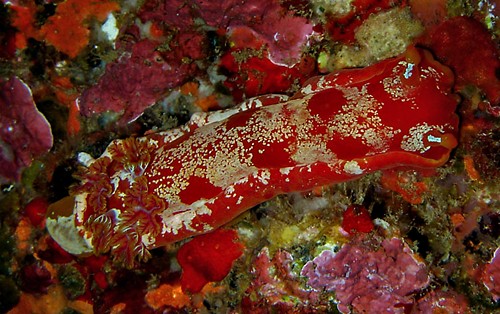
| Maximum size: about 200 mm. Identification: This species is one of the largest Hawaiian nudibranchs. Mature animals are crimson, usually with patches of opaque white. When the animal is at rest, the mantle edge is rolled but, when disturbed, it's flared revealing a yellow-white margin. The oral tentacles are unusual in that they resemble tiny hands. As with other species of Hexabranchus, it undergoes complex changes in color and form as it matures. Very young animals are translucent-cream with faint red lateral patches on the notum and a yellow mantle margin. In maturing animals, the lateral patches darken and a submarginal red band appears. As the animals reach maturity, the rest of the notum darkens to red obscuring those features and opaque white patches may appear, particularly in the areas between the original lateral red patches. However, the amount of opaque white in mature animals is highly variable. (Note 1) In very large animals, the spotting may become finer (but more extensive) and the white patches may become less bright/well-defined. At all stages, the yellow-white margin is retained. It can be distinguished from Hexabranchus sandwichensis by the presence of a yellow-white marginal band at all sizes and the lack of violet spots in juveniles. See the article on this site for further discussion. Natural history: Hexabranchus aureomarginatus is a common nocturnal species in moderately exposed to highly exposed rocky areas from 1-8 m (3-25 ft). It may also be found in tide pools at more exposed sites. Although it often conceals itself under rocks or in crevices during the day, it sometimes rests in the open and may even remain active at times. (Note 2) Like many dorids, it obtains protective chemicals from its sponge food and Scott Johnson reports it feeding on a yellow sponge. (see photo) (Note 3) It is one of the few dorids that can leave the sea floor and swim when threatened--the "dance" referred to in its common name. When swimming, the mantle margin is unrolled to reveal a yellow-white band and there is strenuous dorso-ventral flexing, perhaps serving to elicit a startle response or advertise its toxic nature to potential predators (in addition to swimming). The commensal imperial shrimp, Zenopontonia rex (= Periclimenes imperator), is sometimes found living on its body, often among the gills. Its egg mass is large and conspicuous consisting of 1-5 light pink coils often laid in an exposed location such as the top of a piece of coral rubble or rocky spur. The ribbon is typically more loosely coiled, narrower and more lightly colored than in Hexabranchus sandwichensis egg masses. The eggs are very small and deposited in discrete packets of a few dozen that are embedded in the ribbon. Defensive chemicals are deposited in the egg mass at much higher concentrations than in the nudibranch itself (Scheuer, 1990) so the masses are protected during their week-long development. However, as in H. pulchelus, the egg masses are still eaten by Favorinus japonicus (see photo). Distribution: Big Island, Maui, Lanai, Molokai, Oahu, Kauai and Midway. Taxonomic notes: This species is illustrated in Bertsch and Johnson, 1981 as Hexabranchus sanguineus. It's also listed as H. sanguineus in Hoover, 1998 & 2006 (left photo) (corrected in 5th printing). The species name means "gold margined" and it is one of the species commonly referred to as the "Spanish dancer" in Hawaii and elsewhere. In the 5th printing, Hoover, 2006 refers to is as the "yellowmargin Spanish dancer." It was first reported from Hawaii in Ostergaard, 1950 (as Hexabranchus sp.). Photo: PF: Keopuka Rock, Maui; Sept. 2, 2007. Observations and comments: Note 1: We've seen photos of animals with extensive white pigment on the notum and no white pigment on the notum copulating (supporting lumping the two extremes). Note 2: On Maui, we've only seen this species resting under shaded ledges during the day or crawling actively at night. However, on May, 3, 2012 we observed at least seven animals crawling in the open by day in tide pools at Po'ipu Beach Park, Kauai. The following night, when we returned to the same pools, we found none. This suggests more flexible behavior than our Maui observations with at least some diurnal (or crepuscular?) activity. The daytime sightings were in the morning under cloudy conditions. Note 3: On May 10, 2012 at Ho'ai Bay on Kauai, Darcy Kehler found a large convex crab, Carpilius convexus, feeding on a mature H. aureomarginatus in shallow water. The nudibranch showed extensive damage to its mantle and had secreted a large quantity of mucus. So, it may be preyed on by some crustaceans in spite of its chemical protection. |
| Thumbnails |
Species
list |
Family | Next species | Top |